
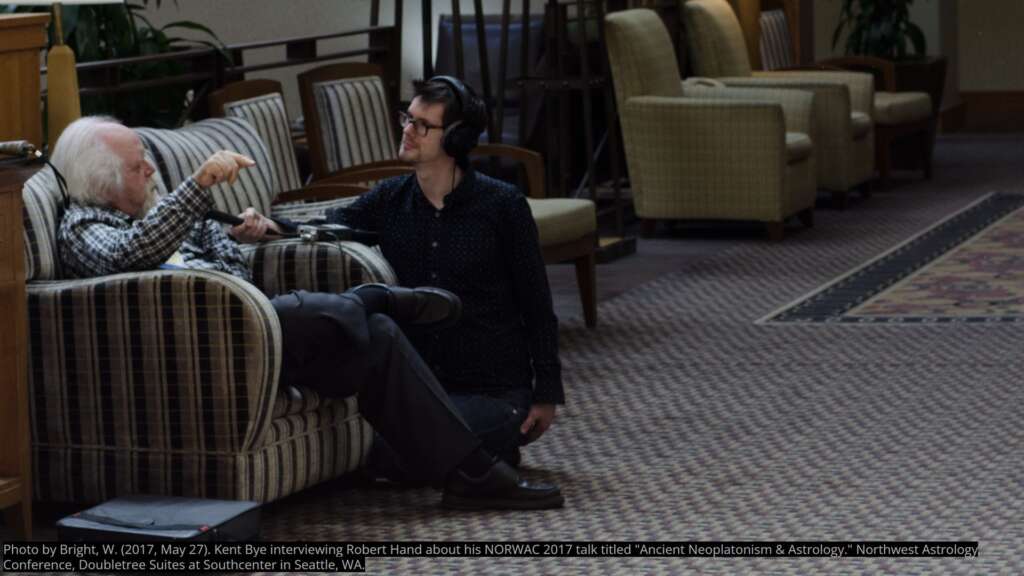
Kent Bye, host of Voices of VR, is relaunching his astrology podcast in 2026
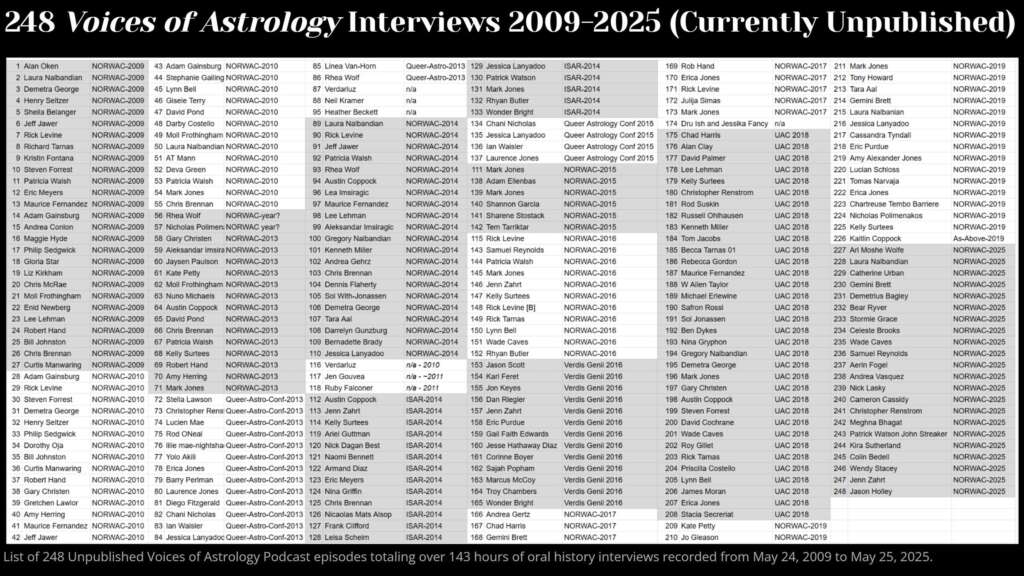
As an oral historian I’ve recorded nearly 250 interviews with astrologers since 2009. Many of these interviews were previously published under the name “Esoteric Voices”, but I took them offline in 2017. I explored the full history and context of these interviews, and why they are currently vaulted, in a section of a talk I gave at NCGR early in 2026 titled, How Astrology Works. The section on the podcast can be found here. The interviews, both formerly published, and previously never aired, will be relaunched as the Voices of Astrology podcast later this year.
My pursuit of these interviews is driven by a fundamental curiosity about what astrology is and how it works. Because I cover the tech industry I encounter strong resistance to astrology, so my interest has been tempered by that, and the conclusions I’ve drawn sharpened. I am keenly aware that astrology is an anomaly that does not neatly fit within a reductive materialist or physicalist paradigm, because I am regularly confronted by people who assume it is, as Richard Tarnas described, the “gold standard of superstition in our culture.”
Since I took my interviews with astrologers offline I’ve been contemplating these questions, but it’s only in the last couple of years that I’ve begun to come up with answers that fully satisfy me. Astrology seemed to promise that reductive materialist and physicalist paradigms couldn’t explain everything, but in searching for the answers to, “what is astrology and how does it work?”, I stumbled across a framework for understanding astrology, and with it, the cosmos, in a way that has deepened my appreciation for mysteries rather than dampened them.
Philosophy of Astrology
Understanding what astrology is starts with recognizing that it is both a robust system for describing the archetypal dynamics of the human experience, and a medium that poises challenging metaphysical questions about the underlying nature of consciousness and reality itself. Searching for a framework that could explain how it works led me to Process Philosophy, which eventually led me to make the argument that Process Philosophy could be seen as the underlying metaphysical foundation for astrology.
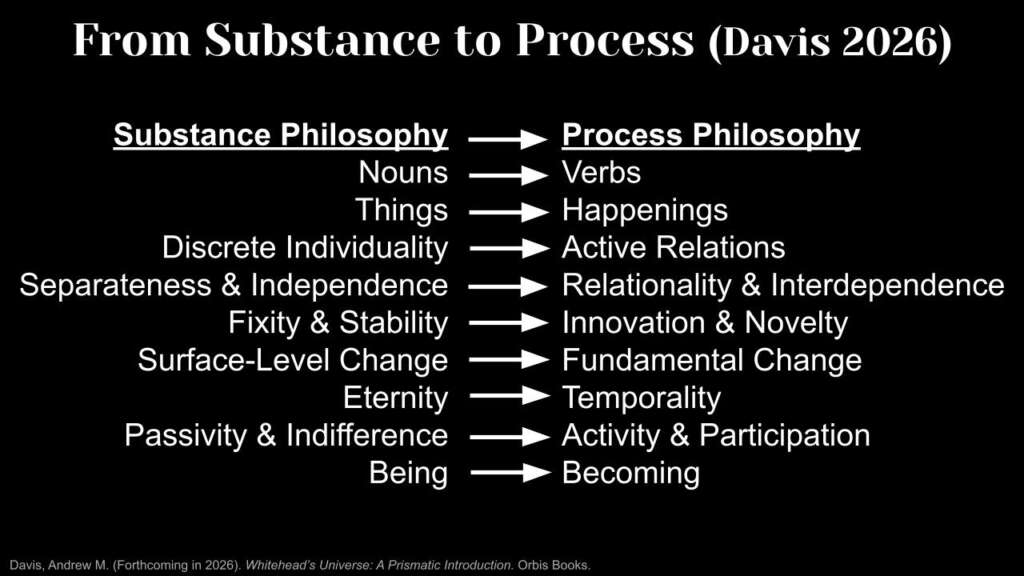
Astrology presents empirical phenomenological data that requires a broader philosophical paradigm shift away from reductive materialism. Alfred North Whitehead’s Process-Relational Philosophy lays out a foundation for this paradigmatic shift away from substance metaphysics towards a process-relational metaphysics, and an event ontology, where time, consciousness, and relationships are more fundamental than space. Here’s a graphic from Andrew M. Davis’ forthcoming book Whitehead’s Universe that describes aspects of this paradigm shift:
Tarnas’ work on Cosmos & Psyche & Passion of the Western Mind fleshed out some underlying Neoplatonic and Jungian foundations for astrology. Jung himself was completely fascinated by astrology as explored in recent scholarship by Safron Rossi and Keiron Le Grice in Jung on Astrology, as well as Liz Greene’s Jung’s Studies in Astrology. Rossi and Le Grice aggregated seven different possible explanations of astrology that Jung explored:
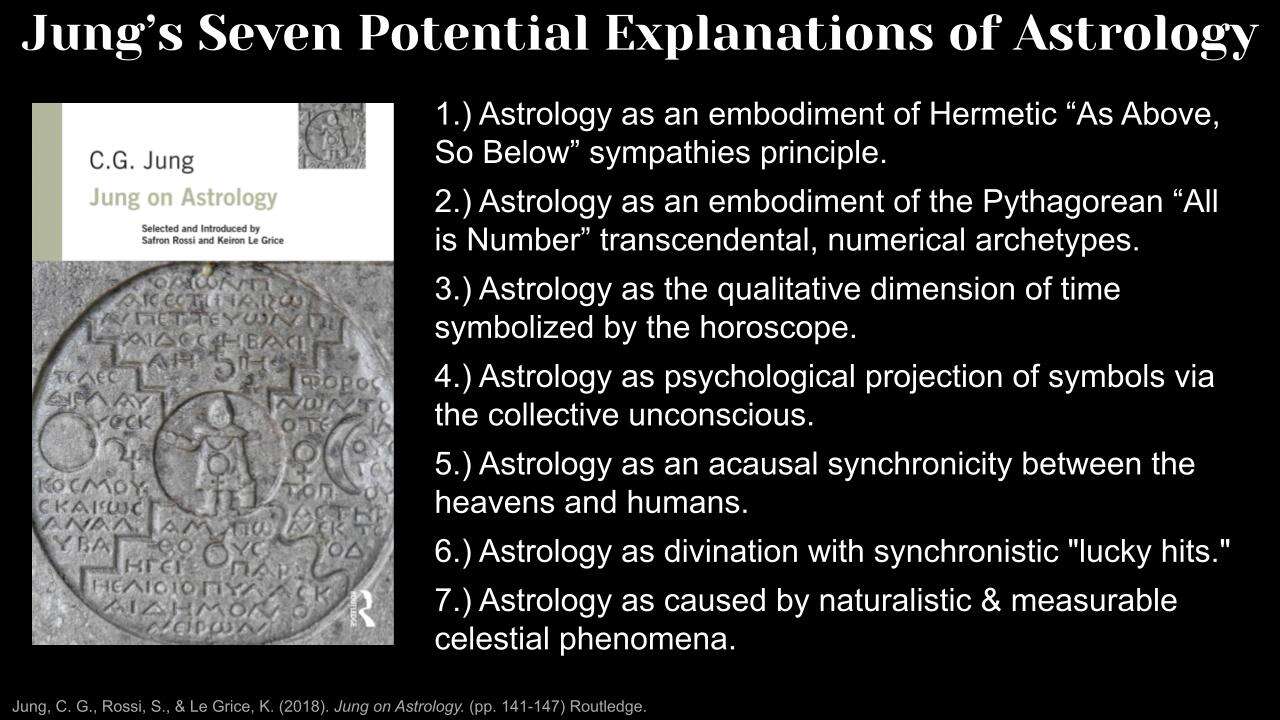
I have given a number of talks where I elaborate on how Alfred North Whitehead’s Process Philosophy could provide a solid metaphysical foundation for astrology. Tarnas references Whitehead a dozen times in Cosmos & Psyche, including in a passage where he’s describing how various philosophers have treated the concept of archetypes throughout history, “in Whiteheadian terms as eternal objects and pure potentialities whose ingression informs the unfolding process of reality.” Here’s a graphic that shows how some of Whitehead’s theories of concrescence might map over to the elements.
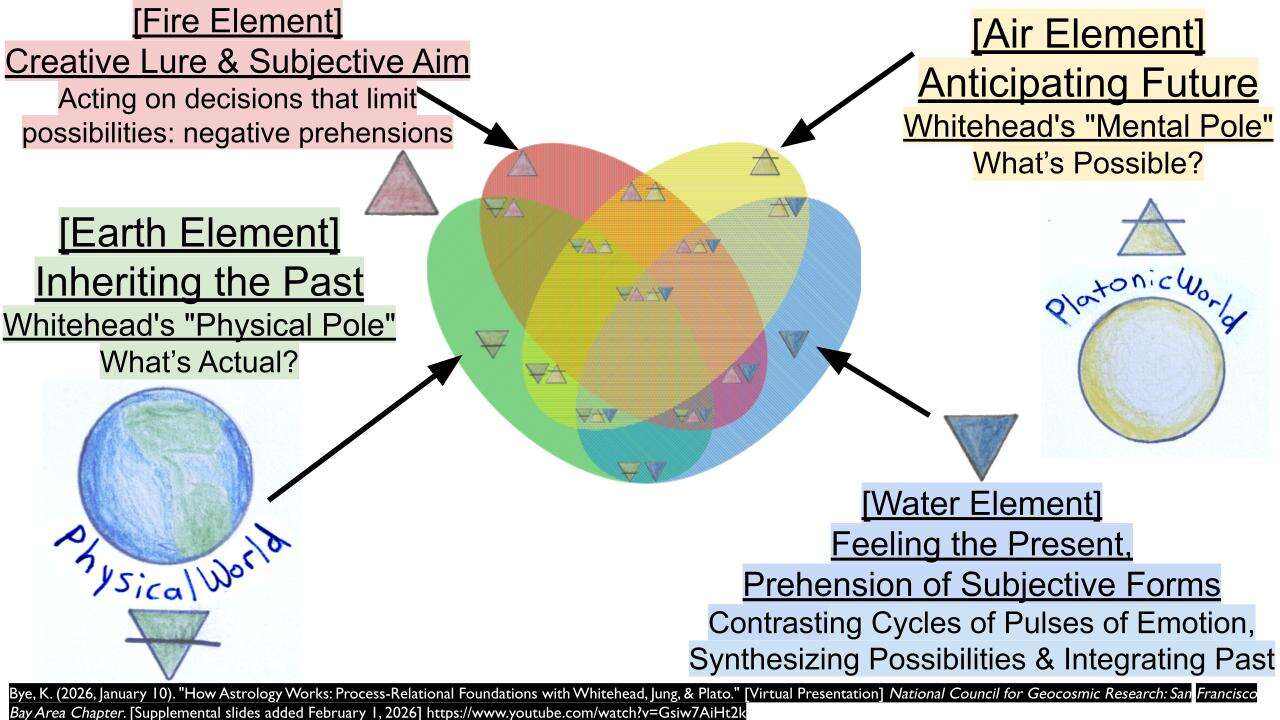
Grant Maxwell explored the intersection between Whitehead’s Process Philosophy and astrology in the Archai Journal in 2011 with his piece “Archetype and Eternal Object: Jung, Whitehead, and the Return of Formal Causation,” and Becca Tarnas explored in the Archai Journal in 2017 with her piece “Everlasting Concrescence: A Process-Relational Cosmology.” Whitehead scholar Matt Segall also briefly mentions Whitehead in his 2016 Archai Journal article, “Minding Time in an Archetypal Cosmos.” I’ve published five interviews with Whitehead scholars and philosophers including Segall three times, Maxwell, as well as Andrew M. Davis.
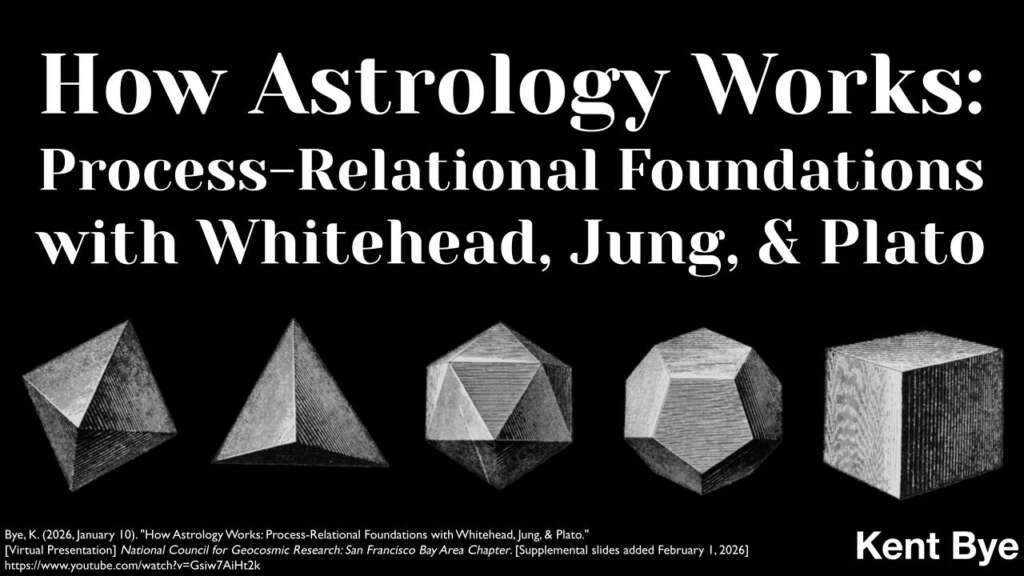
I’ve given a number of talks over the last five months exploring the philosophy of astrology including “How Astrology Works: Process-Relational Foundations with Whitehead, Jung, & Plato” given virtually to the National Council for Geocosmic Research: San Francisco Bay Area Chapter given on January 10, 2026. Here is the PDF of the slides.
I also had the opportunity to give an abbreviated version of this talk to other professional philosophers at the Mind-at-Large conference on April 16, 2026. The Mind-at-Large conference is a “multidisciplinary inquiry into consciousness and its role in the nature of reality. Rooted in philosophy yet reaching across the sciences, the arts, and spiritual traditions, the project challenges the prevailing assumption that mind is confined to human brains alone. Instead, it explores the possibility that consciousness is fundamental, relational, and potentially cosmic in scope.” The title of my talk was “Archetypal Process: Astrology as a Framework for Panexperientialism.” Here are the slides from that talk, and the video will be coming soon.
I’ve been generalizing aspects of astrology into an experiential design framework to help break down the components of immersive storytelling and immersive art. I gave a talk at Storycon in Brussels, Belgium on May 5, 2022 titled “A Primer on Presence, Immersive Storytelling, & Experiential Design” (slides) where I talk about my elemental theory of presence.
I also gave a talk at the World Astrology Summit: Mundane-Themed Conference by Skyscript and In Mundo on March 22, 2026 about “Mundane Tech Cycles and the Philosophy of Astrology.” (slides).
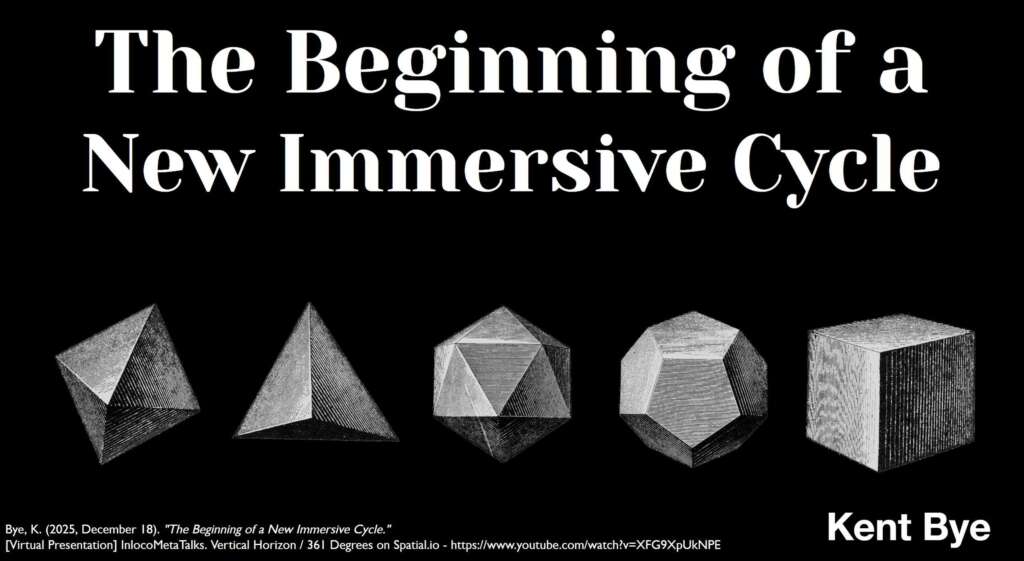
And I gave a virtual talk on how Saturn and Neptune represents “The Beginning of a New Immersive Cycle” on December 18, 2025 (slides), which revisits a paper that I wrote for Archai Journal in 2017 titled “The Archetypal Cycles of Virtual Reality” laying out the various outer planet cycles associated with emerging technologies.
I also recently wrote a 121-page paper that tracks the latest trends of immersive storytelling and location-based entertainment that was published on April 21, 2026 and features lot of theme of the Saturn-Neptune complex.
I’ll likely expand this post with more details on my thoughts on the philosophy of astrology, but I wanted to provide some references to some of my work on the topic.
-Kent Bye.
First draft published on May 20, 2026 at 1:07pm PDT.